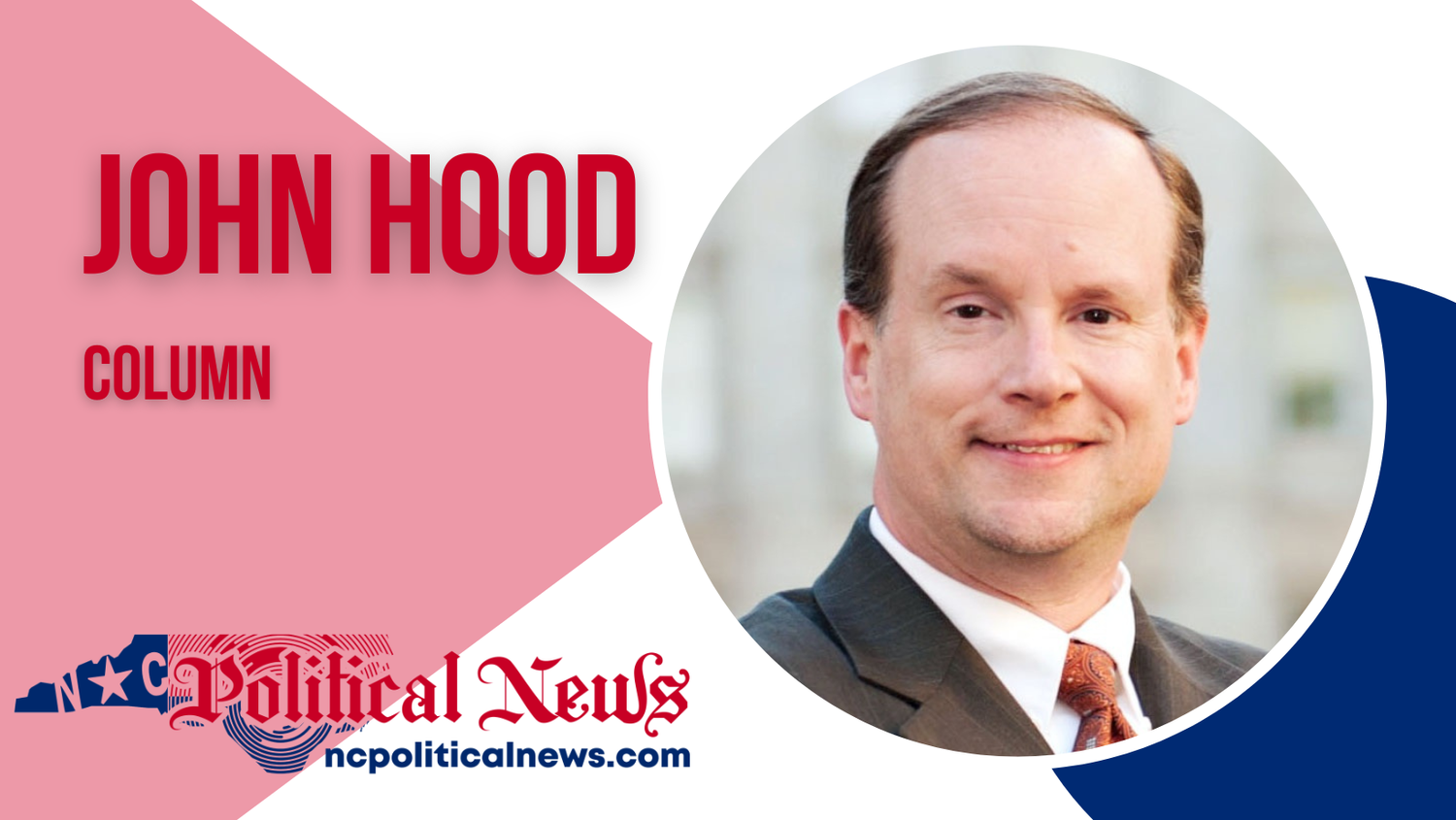
John Hood: When Think Tanks Lose Their Way
RALEIGH — Think tank is a funny term for a serious enterprise. For more than a century — the first one was the Brookings Institution, founded in 1916 — think tanks have played important roles in American politics and government. They’ve developed and promoted ideas. They’ve turned them into actionable policies. And they’ve trained policy professionals who went on to work on Capitol Hill, in presidential and gubernatorial administrations, and in electoral politics.
Think tanks aren’t easy to manage, however. The Heritage Foundation, one of the largest in the world, has had a rough few weeks.
After a disastrous decision by CEO Kevin Roberts to publicly defend the increasingly unhinged Tucker Carlson and Carlson’s fawning interview with racist podcaster Nick Fuentes, Heritage drew fire from across the political spectrum — and from inside the organization itself. Roberts issued a quasi-apology, then tried to change the subject. It didn’t work. A task force on antisemitism cut its ties with Heritage. Three board members resigned, as did prominent staffers such as economist Stephen Moore and former American Enterprise Institute president Chris DeMuth.
The Monday before Christmas brought even worse news for the organization. The leaders of three key Heritage units — the Edwin Meese Center for Legal and Judicial Studies, the Thomas A. Roe Institute for Economic Policy Studies, and the Center for Data Analysis — left to join a rival think tank, Advancing American Freedom. Most of their employees followed them to AAF, which is led by former Heritage chief of staff Tim Chapman, was founded by former Vice President Mike Pence, and is chaired by Marc Short, a White House and Capitol Hill veteran who was once Pence’s chief of staff.
While Roberts’ foolish defense of Carlson lit the fuse, Heritage’s implosion is about more than the troubling rise of bigotry, crankery, and conspiracism in some corners of the American Right (and Left). Under Roberts and his inner circle, the Heritage Foundation has downplayed or abandoned large swaths of traditional American conservatism — on such matters as free trade, fiscal restraint, and the rule of law — and moved towards a nationalist populism. It has also increasingly subordinated its proper role, as a principled purveyor of ideas, to the baldly partisan project of adulating President Trump and making J.D. Vance his political successor.
As a former Heritage employee myself — I was a visiting fellow 30 years ago alongside, of all people, Tucker Carlson — I find the organization’s descent into chaos personally distressful. As the former president of a conservative think tank, however, I find it unsurprising. To remain in ivory towers and build no relationships with policymakers is to wield little influence. But think tanks can also lose their way by losing critical distance and sacrificing long-held positions to maintain access or make small, often-fleeting policy gains.
On this subject, as on so many others, the statesman Edmund Burke offered sound advice. Good government is built on “prudence, deliberation, and foresight,” he wrote in his Reflections on the Revolution in France, while “flattery corrupts both the receiver and the giver.”
For most of its history, the Heritage Foundation struck the right balance. While enjoying tremendous success during Ronald Reagan’s presidency, for example, it didn’t flinch from pushing back, respectfully but firmly, against administration policies it deemed unwise. Over the ensuing decades, Heritage generally treated other conservative presidents, members of Congress, governors, and other leaders the same way.
At this pivotal moment, America needs a robust conservative movement to defend the core principles of our national experiment — including limited government, individual liberty, the separation and decentralization of power, religious pluralism, and equality before the law — against encroachment by both the progressive Left and populist Right. Hundreds of conservative leaders have, indeed, committed to doing just that as signatories to the Freedom Conservatism Statement of Principles.
When we debuted the FreeCon statement in 2023, it bore the names of several Heritage scholars. They were soon compelled to remove their names. It was a telling sign of things to come.
John Hood is a John Locke Foundation board member. His books Mountain Folk, Forest Folk, and Water Folk combine epic fantasy with American history (FolkloreCycle.com).
Are you tired of being bombarded by paywalls and pop-up ads when trying to read the news? Do you believe that access to reliable political news should be free and accessible to everyone? Then we urge you to support NC Political News, a weekly electronic political news outlet.
NC Political News is committed to providing high-quality, unbiased political reporting with columnists from all political sides. Unlike other news outlets, NC Political News is free to read and supported by businesses who purchase ad space on our website and in our newsletter, which goes out Monday through Friday at 7:00 am. This means that readers like you can access the news without being asked to pay a cent or dealing with frustrating advertisements.
However, to continue providing this valuable service, NC Political News needs your support. If you believe in the importance of accessible, free news, we urge you to click the image below. Any amount of support is appreciated.
Together, we can keep the news free and help ensure our state stays informed and connected.