
NC state employee and teacher reps say health insurance increases will hurt worker retention
The NC State Health Plan has been relying on cash reserves to pay bills. State employees will now be asked to pay higher premiums for their care. (Photo by Thomas Barwick/Getty Images)
NC state employee and teacher reps say health insurance increases will hurt worker retention
by Lynn Bonner, NC Newsline
August 15, 2025
The board overseeing the health insurance plan for North Carolina workers and retirees voted Friday to raise most enrollees’ premiums to help cover a deficit that has grown to $507 million this year.
State Treasurer Brad Briner, whose office oversees the health plan, said no one wants to increase premiums but the hikes are needed to remedy the plan’s financial instability.
The insurance plan has been relying on cash reserves to pay bills because it has been paying out more than it has taken in. The reserves are running low.
State employee and teacher representatives told the board that low wages and higher insurance premiums will push workers out of their jobs and make it even harder to fill vacancies.
While premiums are increasing, state employees and teachers are not guaranteed raises this year. Republicans in the state House and Senate have not agreed on a comprehensive budget that includes state employee and teacher raises.
“We know that the State Health Plan has financial challenges, but this board’s responsibility is not to balance those challenges on the backs of the people who work with our kids every single day,” said Bryan Proffitt, vice president of the NC Association of Educators. “Your job is to protect the health and well-being of people who serve this state.”
The board should demand more funding from legislators, Proffitt said, because they should not have a “free pass” to underfund schools and benefits.
Ardis Watkins, executive director of the State Employee Association of North Carolina, blamed the healthcare industry for high prices.
“This health plan had been an ATM for the corporate health care machine,” she said.
Without raises and with inflation, state employees are already falling behind, Watkins said.
In May, the health plan trustees voted to increase enrollees’ out of pocket costs.
Cherry Hospital employee Charles Owens told the board that the psychiatric hospital in Goldsboro is understaffed, forcing workers to endure 12- and 16-hour shifts.
“A steady paycheck and a decent health care benefit were the last things that were assisting us in getting new hires and retaining permanent staff,” he said. Health plan trustees should have waited to know the size of employee raises before saddling them with higher insurance costs, Owens said.
The health plan has not increased premiums in seven years.
The plan sets up four salary tiers. Employees who make $50,000 or less and insure only themselves under the basic plan will see increases of $10 per month to $35. Workers in the top tier who make more than $90,000 will pay $80 in premiums for comparable coverage.
Premiums will be reduced for enrollees who include their children in their insurance plans.
Adding more insured children will help improve the plan and help single parents, said Health Plan executive administrator Tom Friedman.
Briner said he was faced with the health plan deficit when he took office this year. He placed the responsibility on former state Treasurer Dale Folwell, though he did not mention Folwell by name.
“We’re here because of the short-sighted decisions of my predecessor,” Briner said. “Premiums were frozen for years, and members were made to believe they could be that way forever. The plan was actually spending more money than it took in each and every year. That meant cash reserves through the plan were being used to keep prices stable rather than doing the hard work with providers and making adjustments to get better services and lower prices for our members.”
A plan developed under Folwell called the Clear Pricing Project was intended to save the health plan money. It ended up being a financial drain.
Folwell wanted to peg health plan medical costs to Medicare reimbursement rates. The legislature didn’t go along, so the program remained voluntary.
Both Briner and Friedman praised legislators for including $150 million in the stop-gap budget the General Assembly passed last month to help close the deficit.
Without that infusion, premiums would have gone much higher, Friedman said.
But in an interview with NC Newsline Friday, Folwell blamed the legislature for the health plan’s money problems.
The General Assembly did not properly fund the plan, have the courage to take on the “healthcare cartel,” or get rid of a law called certificate of need, Folwell said. Under the certificate of need law, some kinds of providers need state permission to set up shop or offer certain services.
Folwell was elected treasurer in 2016 and was in office until January of this year.
“Raising premiums on state employees is the direct result of the General Assembly not funding the plan or doing its job,” Folwell said. “That’s true yesterday, it’s true today, and it’s going to be true tomorrow.”
Click here to view the full presentation to the State Health Plan Board of Trustees.
NC Newsline is part of States Newsroom, a nonprofit news network supported by grants and a coalition of donors as a 501c(3) public charity. NC Newsline maintains editorial independence. Contact Editor for questions: info@ncnewsline.com.

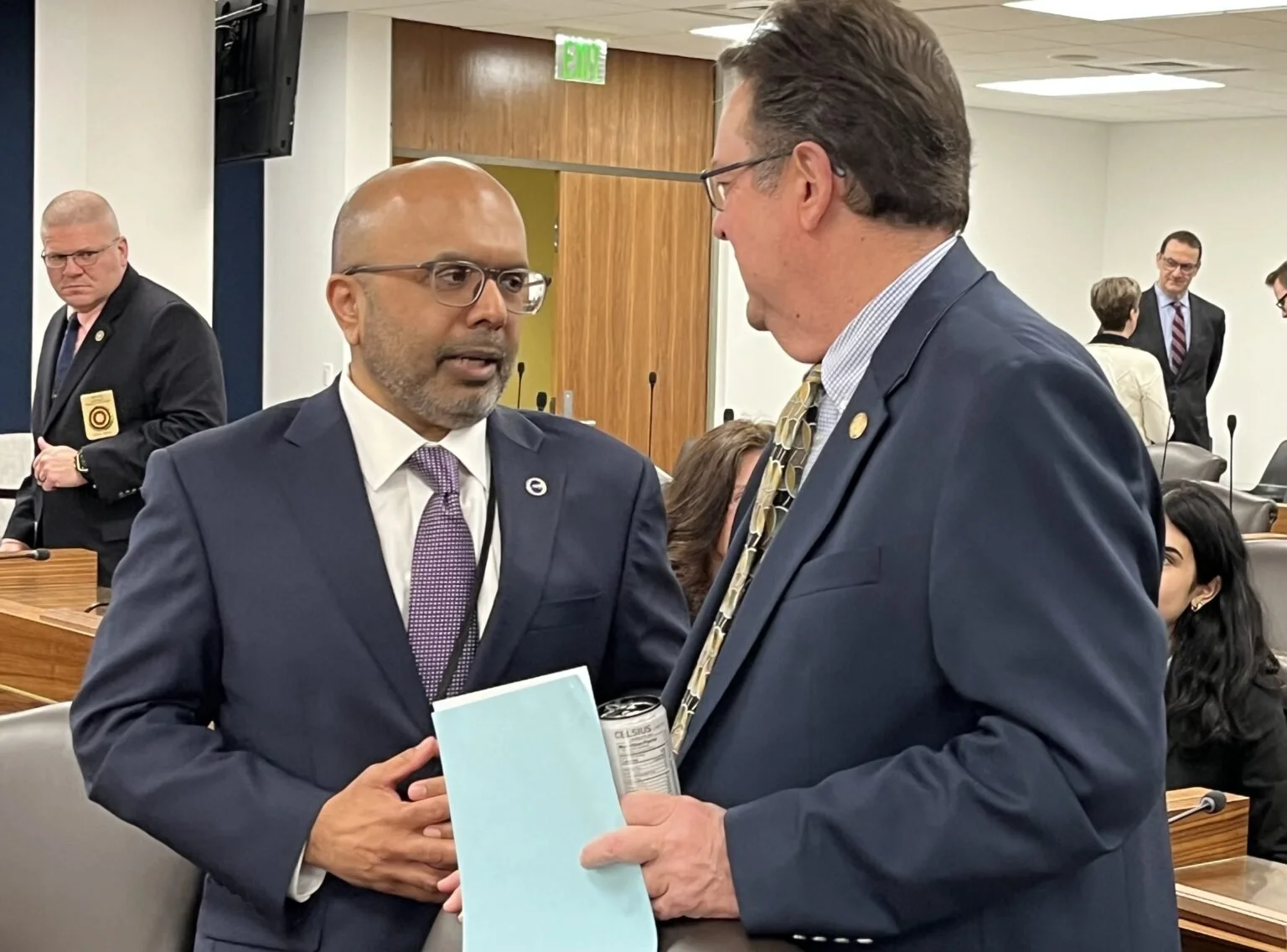
NC Treasurer Brad Briner and state Health Plan administrator Tom Friedman talk about insurance plan finances. (Photo: Lynn Bonner/NC Newsline)
Are you tired of being bombarded by paywalls and pop-up ads when trying to read the news? Do you believe that access to reliable political news should be free and accessible to everyone? Then we urge you to support NC Political News, a weekly electronic political news outlet.
NC Political News is committed to providing high-quality, unbiased political reporting with columnists from all political sides. Unlike other news outlets, NC Political News is free to read and supported by businesses who purchase ad space on our website and in our newsletter, which goes out Monday through Friday at 7:00 am. This means that readers like you can access the news without being asked to pay a cent or dealing with frustrating advertisements.
However, to continue providing this valuable service, NC Political News needs your support. If you believe in the importance of accessible, free news, we urge you to click the image below. Any amount of support is appreciated.
Together, we can keep the news free and help ensure our state stays informed and connected.