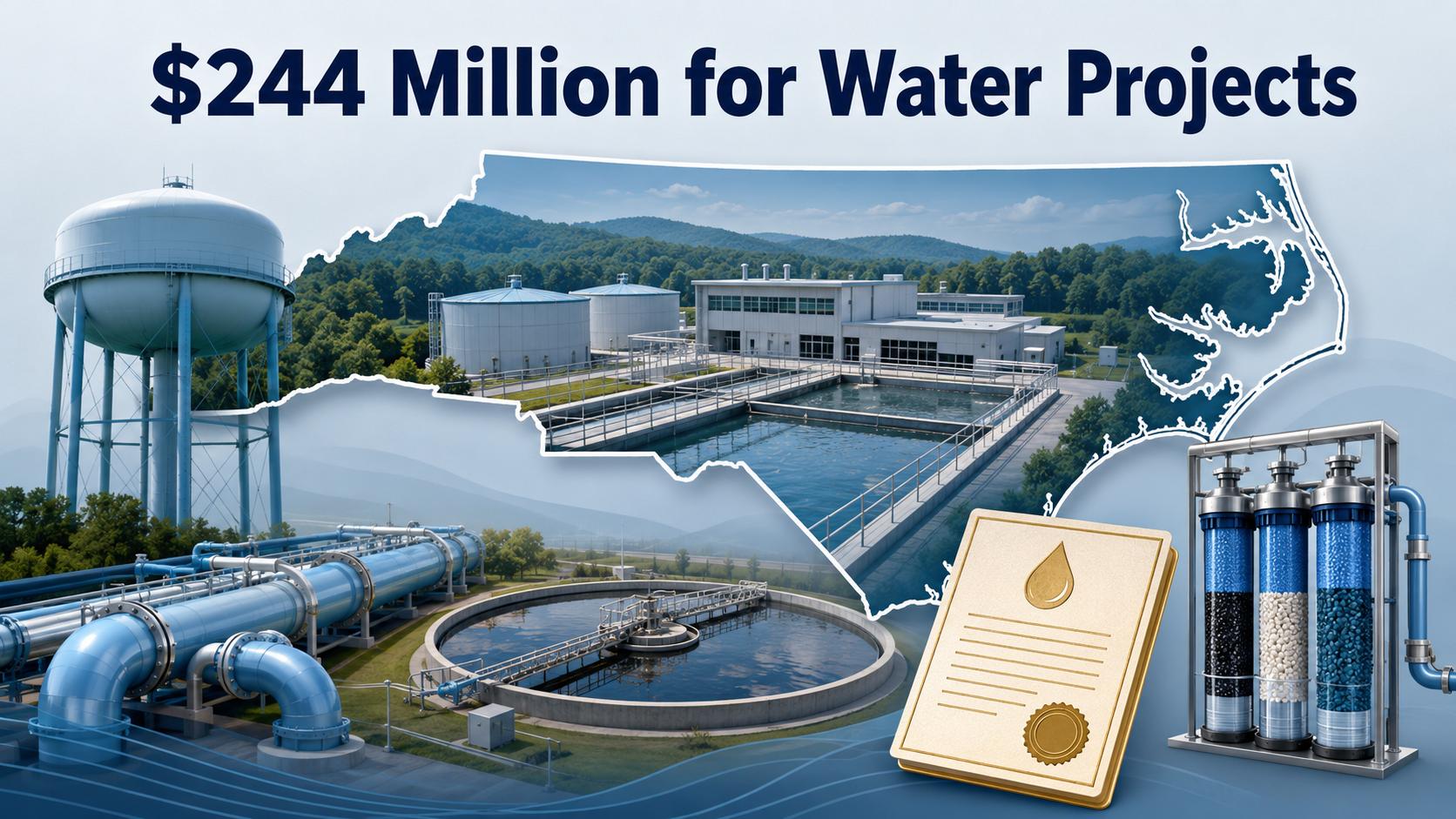
North Carolina awards $244 million for water and wastewater projects
Forty-five projects across 28 counties will address aging infrastructure, PFAS contamination, lead service lines, failing septic systems and storm resilience.
RALEIGH — North Carolina has approved more than $244 million for drinking-water and wastewater projects in 28 counties, including work to address PFAS contamination, replace lead service lines and strengthen water systems against flooding and future storms.
The State Water Infrastructure Authority approved funding for 45 projects during its July 15 meeting. Approximately $44 million will support projects in western North Carolina connected to Hurricane Helene recovery and infrastructure resilience.
The projects are being financed through a combination of state and federal programs, including the Clean Water State Revolving Fund, Drinking Water State Revolving Fund, Community Development Block Grant-Infrastructure program and funds provided through the federal Infrastructure Investment and Jobs Act.
The Division of Water Infrastructure received 123 applications requesting a combined $1.6 billion, substantially more than the amount available during this funding round.
Among the approved projects, the South Granville Water and Sewer Authority will receive approximately $21.9 million for PFAS treatment improvements. Siler City and TriRiver Water will receive $5 million for PFAS treatment construction.
Hendersonville will receive $35 million for flood-mitigation work at its wastewater treatment facility. Graham will receive approximately $26.6 million for improvements to the Graham-Mebane Water Treatment Plant.
Several eastern North Carolina communities are also included. Newport will receive approximately $13.4 million to improve or replace its water-treatment plant. The Village of Simpson in Pitt County will receive approximately $10.1 million for wastewater collection-system improvements.
Pitt County will receive a $250,000 loan through a pilot program intended to repair or replace failing septic systems.
Other projects will locate and replace lead service lines. Marion will receive more than $4.4 million for lead and copper service-line replacement and inventory work. Littleton will receive approximately $2.4 million for lead service-line projects.
The funding includes grants, low-interest loans and loans that may qualify for partial forgiveness, depending on the program and recipient.
The Division of Water Infrastructure will open another funding round Aug. 4. Applications will be accepted through Sept. 30. Training sessions are scheduled in Hickory, Asheville, Durham and Kinston, with a virtual training option also planned.
The governor’s office and Department of Environmental Quality said the projects are intended to improve water quality, protect public health, support economic growth and help local systems withstand severe weather.
Editor’s note: This article was drafted with the assistance of artificial intelligence and was reviewed and fact-checked by a member of the NC Political News editorial team before publication.