Republicans overtake Democrats on NC voter rolls
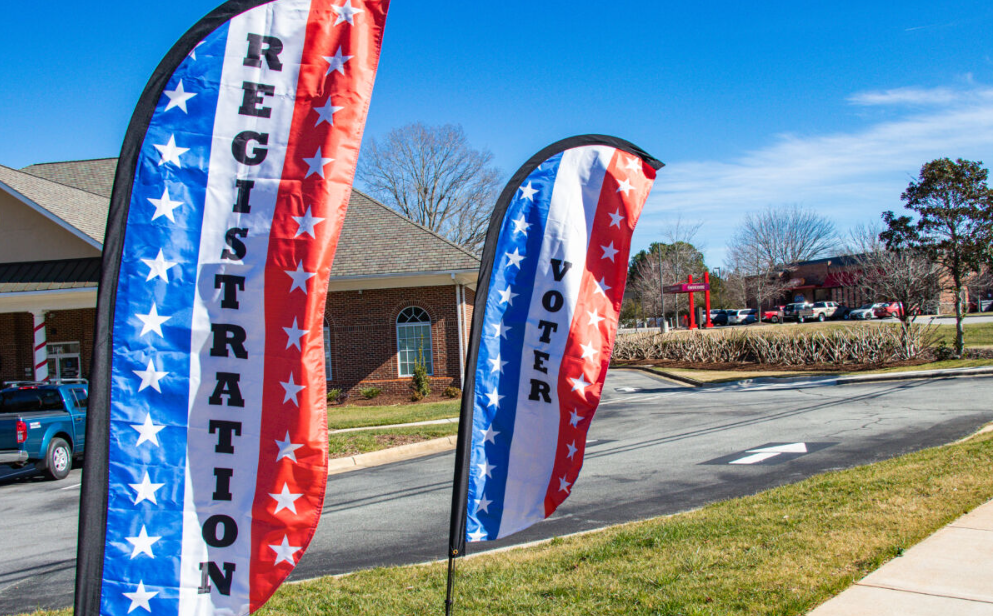
Voter Registration Flags Source: Jacob Emmons, Carolina Journal
CJ Staff
January 3, 2026
Voter Registration Flags Source: Jacob Emmons, Carolina Journal
Listen to this story (4 minutes)
For the first time in state history, registered Republicans now outnumber registered Democrats in North Carolina, according to the most recent voter registration snapshot based on data from the North Carolina State Board of Elections.
Official Voter Registration Numbers (as of Jan. 3, 2026):
Republicans: 2,315,067
Democrats: 2,312,990
Unaffiliated (no party): 2,976,558
Green: 4,376
Libertarian: 46,608
Total registered voters: 7,655,591
Figures out on Saturday show figures Republicans edging ahead of Democrats by 2,077 voters, a historic shift in a state where Democratic registration long held an advantage. The growth of unaffiliated voters has outpaced both parties, with roughly seven in 10 new registrants choosing no party affiliation in the most recent reporting period.
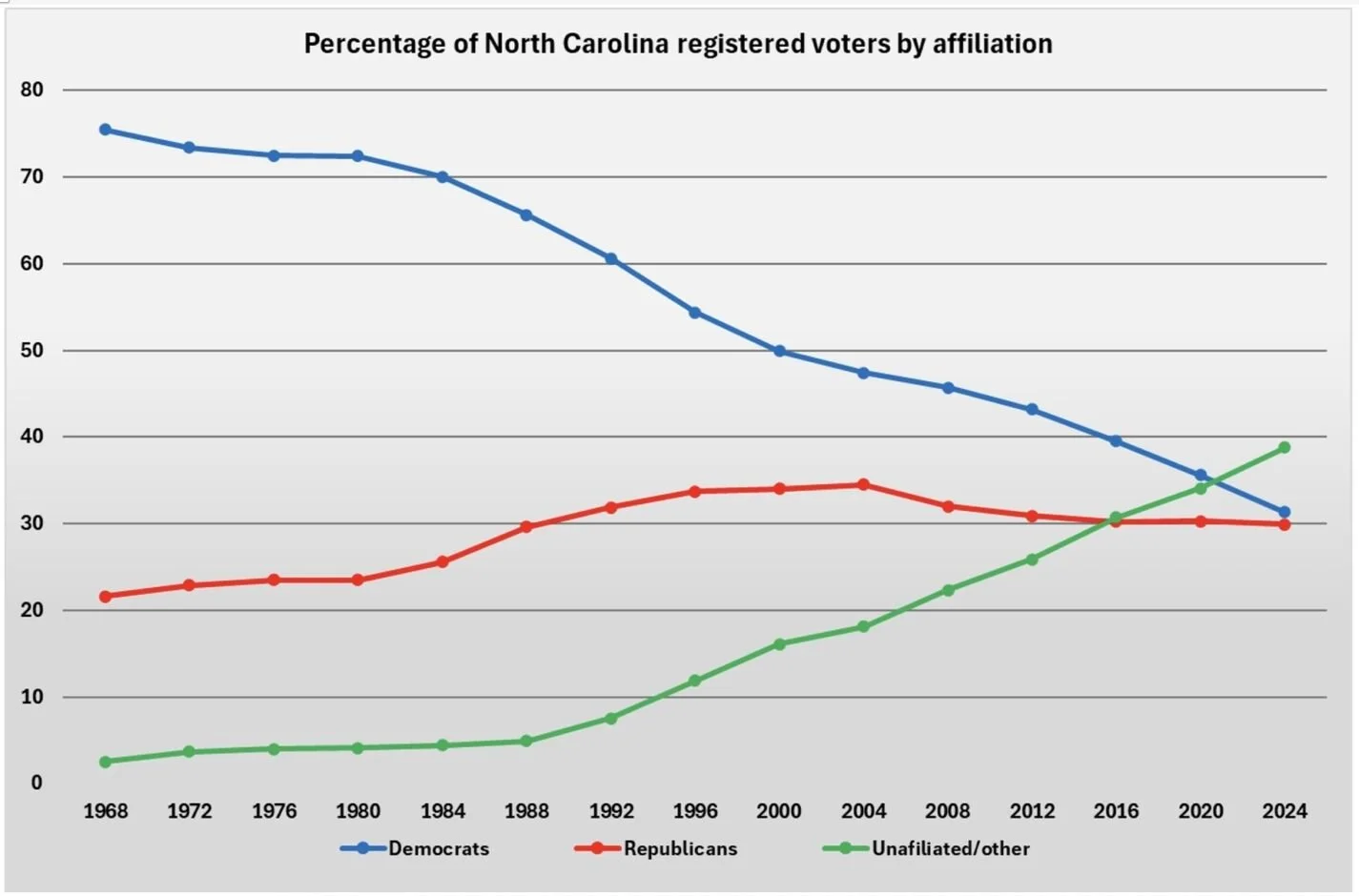
Analysis from the John Locke Foundation places the current shift within a broader historical context. For much of the 20th century, Democrats dominated North Carolina politics, but long-term declines in Democratic registration, alongside steady growth in Republican and unaffiliated registrations, have gradually reshaped the state’s political landscape. That realignment became evident in 2010, when Republicans won majority control of the North Carolina General Assembly, a position they have held since that time while advancing a more conservative agenda focused on lower taxes and reduced spending.
Republican registration was on pace to overtake Democratic registration sometime in early 2026, and the latest data confirm that transition.
https://twitter.com/andyinrok/status/2005631197549154551
https://twitter.com/andyinrok/status/2005631199403012296
Source: The John Locke Foundation
Andy Jackson, director of the Civitas Center for Public Integrity at the John Locke Foundation, said the change in voter registration reflects a gradual political realignment rather than a sudden shift. Over the past two decades, he said, North Carolina’s electorate has become less tied to party labels as Democratic registration declined sharply from its historic dominance and Republican registration increased at a slower, steadier pace. At the same time, population growth, in-migration, and generational turnover have continued to reshape the state’s political makeup.
“The rapid rise of unaffiliated voters, combined with North Carolina’s population growth, has resulted in the proportion of registered Republicans remaining steady over the past three decades, despite an increase in their absolute numbers,” wrote Jackson in a recent Locke article. “During that time, the number and proportion of Democrats have continued to decline.”
Source: The John Locke Foundation
Jackson said the most consequential development during that period has been the rapid expansion of unaffiliated voters, which has altered how both major parties compete for support. Those changes in voter behavior, combined with North Carolina’s semi-open primary system, have reduced the practical need for voters to register with a political party. In 2023, Senate Bill 747 was signed into law. Among other election policies, it barred parties from closing their primaries to unaffiliated voters.
“Unaffiliated voters have been allowed to vote in either party’s primary since the mid-1990s, negating the need to register with a specific party.,” wrote Jackson. “Unaffiliated registrations surpassed Republicans in 2017 and Democrats in 2022.”
While party registration doesn’t directly predict election results, the change reflects evolving political dynamics in North Carolina, a key battleground state. The shift in registration balance comes as candidates prepare for the March 3 primaries and the broader 2026 election cycle, setting the stage for competitive contests at the federal and state levels.