Senate education bill would create high school redesign commission, fund learning programs
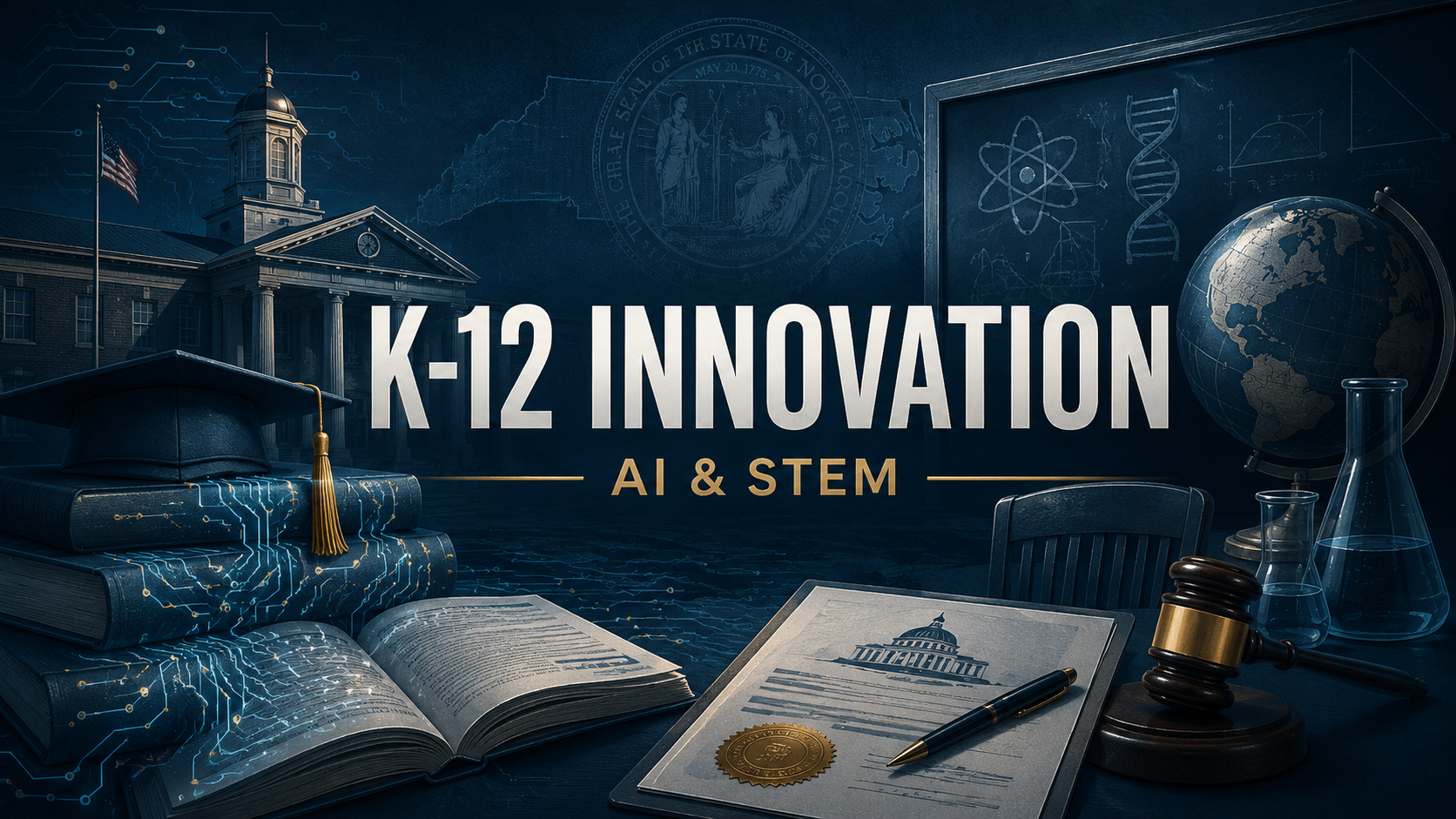
RALEIGH — A North Carolina Senate bill scheduled for committee review Wednesday would create a high school redesign commission, expand work-based and competency-based learning efforts, fund education programs and make changes affecting teacher evaluations and advanced coursework.
Senate Bill 1006, titled the “K-12 Innovation and Transformation Act,” was re-referred May 18 to the Senate Education/Higher Education Committee and, if favorable, would next go to Senate Appropriations/Base Budget. The bill was scheduled for committee consideration Wednesday morning.
The filed bill describes itself as legislation to appropriate money for elementary and secondary public education, make various changes to public education laws and enact provisions to transform the high school experience.
The proposal would establish the North Carolina High School Redesign Commission within the Department of Public Instruction, though the commission would exercise its powers independently of the department. Its stated purpose would be to recommend changes to high school and higher education policies to better prepare students for college or the workforce.
The 15-member commission would include appointees from the General Assembly and governor, the state superintendent or designee, the UNC president or designee, the president of North Carolina Independent Colleges and Universities or designee, the president of the North Carolina Community College System or designee, and leaders or designees from MyFutureNC, the North Carolina Chamber of Commerce, BEST NC and SparkNC.
The commission would examine flexible high school diploma requirements, apprenticeships, internships, clinical experiences, industry-recognized credentials, personalized pathways, competency-based learning, alternatives to traditional semester or yearlong courses and the use of artificial intelligence in career exploration and work-based learning.
The bill would also expand automatic enrollment in advanced courses to include English language arts, not just mathematics. Under the proposal, eligible students who score at the highest level on corresponding exams would be placed in advanced learning opportunities or advanced courses unless a parent or guardian gives written consent for removal.
The measure includes several funding provisions. It would appropriate $8.855 million in recurring funds beginning in the 2026-27 fiscal year for a Learning Accelerator learning lab facilitator allotment. It would also appropriate $6.5 million in recurring funds to be allocated as a grant to SparkNC for administrative costs tied to Learning Accelerator programs and $5.78 million in nonrecurring funds as a directed grant to SparkNC for startup costs related to expansion into additional public schools.
The bill would appropriate an additional $43.3 million in recurring funds for Advanced Teaching Roles salary supplements, bringing the revised net appropriation to $54.2 million. It would also provide an additional $4 million in recurring funds to expand Advanced Teaching Roles grants.
Another section would establish a Teacher Evaluation Pilot Program for the 2026-27 through 2029-30 school years. The program would direct the State Board of Education to select professional evaluation tools intended to support teacher development, career advancement, educator preparation accountability and licensure renewal.
The bill combines broad policy changes with targeted grants and pilot programs. If approved by the education committee, it would still need review by the budget committee before advancing further in the Senate.
Editor’s note: This article was drafted with the assistance of artificial intelligence and was reviewed and fact-checked by a member of the NC Political News editorial team before publication.