Tariffs could wipe out nearly a third of NC farm income, new report says
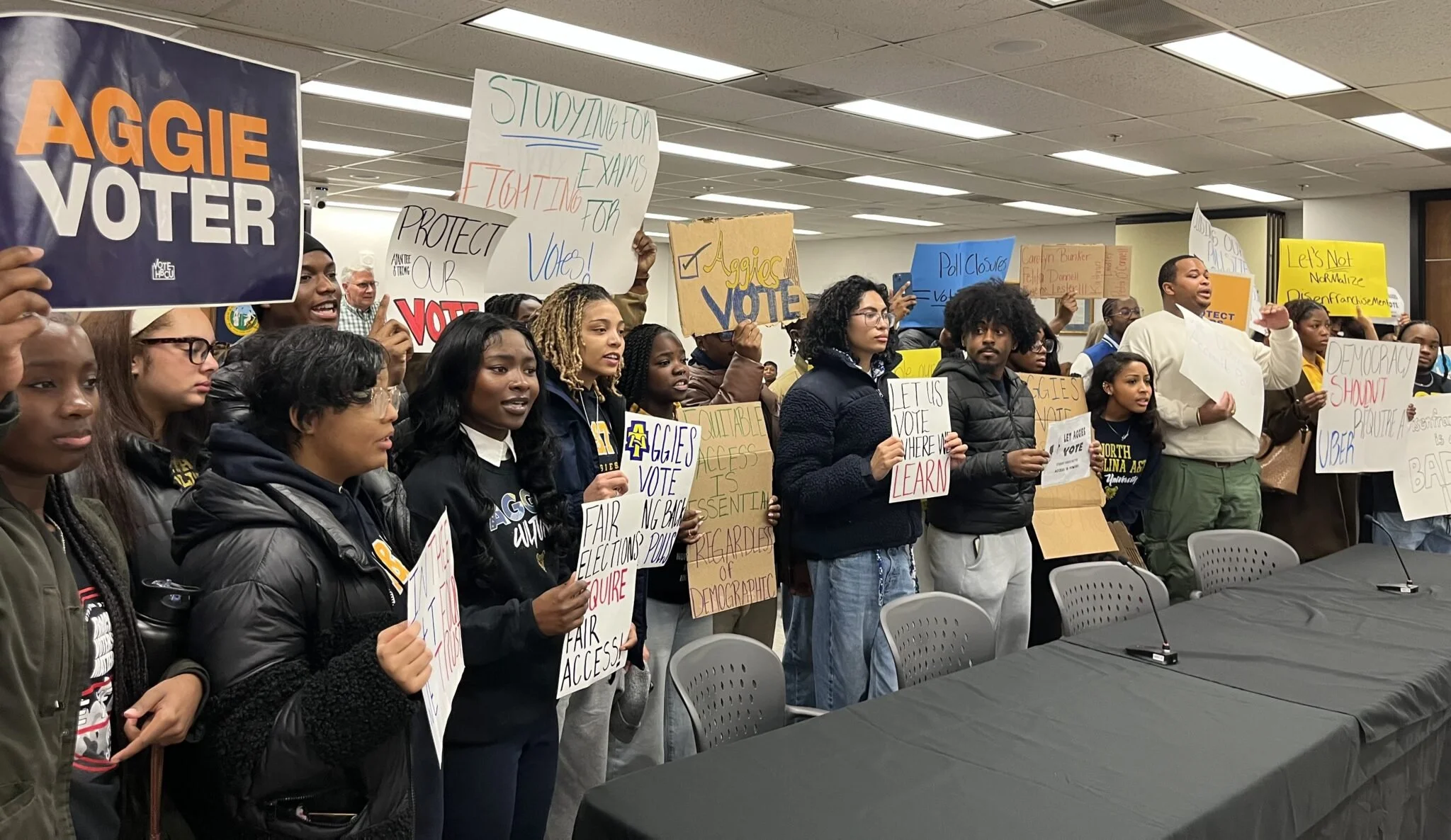
NC A&T State University tried unsuccessfully on Jan. 13, 2026 to have the NC Board of Elections approve a voting site on the Greensboro HBCU’s campus.(Photo: Lynn Bonner/NC Newsline)
Tariffs could wipe out nearly a third of NC farm income, new report says
by Christine Zhu, NC Newsline
January 16, 2026
Retaliatory tariffs could have harsh economic consequences for North Carolina’s agricultural sector, according to a new report from the John Locke Foundation.
Over the past year, President Donald Trump has raised tariffs on foreign imports to the U.S. Major trade partners like the European Union, China and Canada imposed retaliatory tariffs in response, leading to trade wars and increased prices across the board.
“How Tariffs Threaten North Carolina Agriculture: NC Farmers at Risk,” authored by Jeffrey Dorfman at North Carolina State University, estimates the tariffs could cost the state’s farmers about $695 million.
This figure represents roughly a third of average net farm income in North Carolina.
“Such a contraction would lead to a total of roughly 8,000 lost jobs, both directly in the agriculture industry along with the ripple effects from that lost revenue,” Dorfman wrote. “The job losses would be concentrated in North Carolina’s rural communities.”
Other indirect effects on the state’s rural economy would result in an additional $1.2 billion in estimated revenue losses, Dorfman wrote. This brings the potential total economic losses as a result of trade policy retaliation to $1.9 billion, which is more than 2% of North Carolina’s gross state product.
Donald Bryson, CEO of the Locke Foundation, a free-market think tank, said the organization commissioned the study because it has become increasingly concerned about the effect of recent agricultural policies on the state’s food supply chain.
“We are an export-dependent state,” he said. “Agriculture is the largest sector of North Carolina’s economy, and we wanted to know how this is going to be affected by the tariff regime.”
North Carolina Agriculture Commissioner Steve Troxler said tariffs are often difficult to quantify because a lot depends on short-term versus long-term impacts.
Troxler said they’re usually used as bargaining tools.
“If tariffs result in a more open market, that can be beneficial in the long term, but when it gets into a trade war, it does do harm in the short term,” Troxler said in a statement to NC Newsline. “It’s hard to paint tariffs with just one paintbrush.”
North Carolina ranks 15th in the country for exports and 13th for imports by dollar value. It’s also eighth for total gross farm sales of crops and livestock — especially poultry and hogs.
Farmers in the state have a limited set of options for minimizing damage from agricultural exports, Dorfman wrote. These include looking for new markets and focusing on domestic trade.
“Still, while all these are worth pursuing, they are not likely to be sufficient — especially in the short run — to mitigate the risks North Carolina farmers currently face from a potentially damaging tariff regime,” the report read.
The U.S. exported $24.5 billion worth of soybeans in 2024, with China, Mexico, and the EU as the top markets. North Carolina contributes heavily to soybean production.
Soybeans are the U.S.’s top agricultural export, but North Carolina soybeans are rarely exported; instead, they are used domestically to feed local pigs, chickens and turkeys.
Although the state’s soybeans go almost exclusively to animal feed, they are not protected from the risks of trade policy retaliation, Dorfman wrote. China chose not to buy American soybeans for much of 2025, causing the domestic supply of soybeans to soar and lowering their price in U.S. markets.
Independent Journalism for All
As a nonprofit newsroom, our articles are free for everyone to access. Readers like you make that possible. Can you help sustain our watchdog reporting today?
NC Newsline is part of States Newsroom, a nonprofit news network supported by grants and a coalition of donors as a 501c(3) public charity. NC Newsline maintains editorial independence. Contact Editor Laura Leslie for questions: info@ncnewsline.com.
Neuse News is a locally-owned small business startup in downtown Kinston. Our goal is to provide free, hyper-local news to Lenoir, Greene and Jones counties. The kind of news our grandparents read in a format fit for today's times.
We provide this by having supportive advertisers and we encourage you to click on their ads, shop with them, and eat with them. Every bit of financial support is important to help us sustain free, hyper-local news.
Please consider supporting Neuse News with as little as $5 one-time or via a monthly option. Every little bit helps us, help you.