North Carolina’s Medicaid program will expand on December 1 to offer fully subsidized health plans to virtually every legal resident whose household income is at or below 138% of the federal poverty line.

All in Opinion
Now that the North Carolina General Assembly has finally passed a state budget for the 2023-25 biennium — and Gov. Roy Cooper has decided not to veto it, allowing it to become law without his signature — conservatives have a great deal to celebrate. The bill achieves major victories for fiscal restraint, tax and regulatory relief, and education reform, among other important causes.
The Republicans’ Frankenstein experiment that sutured promised Medicaid expansion in North Carolina to expanded legal gambling has failed.
Senate President Pro Tem Phil Berger (R-Rockingham) rarely loses a hand in the political games that play such a prominent role in the work of North Carolina General Assembly.
Charlotte and Raleigh certainly have their problems — as discussed regularly in, among other places, this very spot on the opinion page! But as someone who grew up near Charlotte and now lives near Raleigh, I will also say there’s still more going right than going wrong in our state’s two most-populous communities.
In the waning days of the 2023 legislative session, there seems to be no shortage of ideas of how to reshape North Carolina’s elections. From ballot signature verification to giving the General Assembly appointment power to the State Board of Elections, Republican legislators maintain their changes will instill voter confidence in the system.
Right-of-center politicians, activists, and intellectuals are currently engaged in a vigorous debate about their movement’s present condition and future prospects.
If current surveys are taken as predictive, the Democratic Party will nominate President Joe Biden for reelection next year, the Republican Party will nominate former President Donald Trump, and whoever wins will begin his term in 2025 as one of the most disliked politicians in American history.
North Carolina’s public school students could use some help. From thirty years of the still-ongoing Leandro court case, we know that our school funding is inadequate. Our state’s school funding effort – the amount we spend relative to the size of our economy – ranks dead last in the country.
If you maintain a diversified portfolio of politically active friends — and you really ought to, if you want to perceive the world as it is rather than as you imagine it to be — it’s essential to learn how to best to handle passionate disagreements about controversial issues.
I am disappointed that members of both the North Carolina State House and U.S. House of Representatives are considering passing legislation that will allow major drug companies to increase prescription drug prices to record highs.
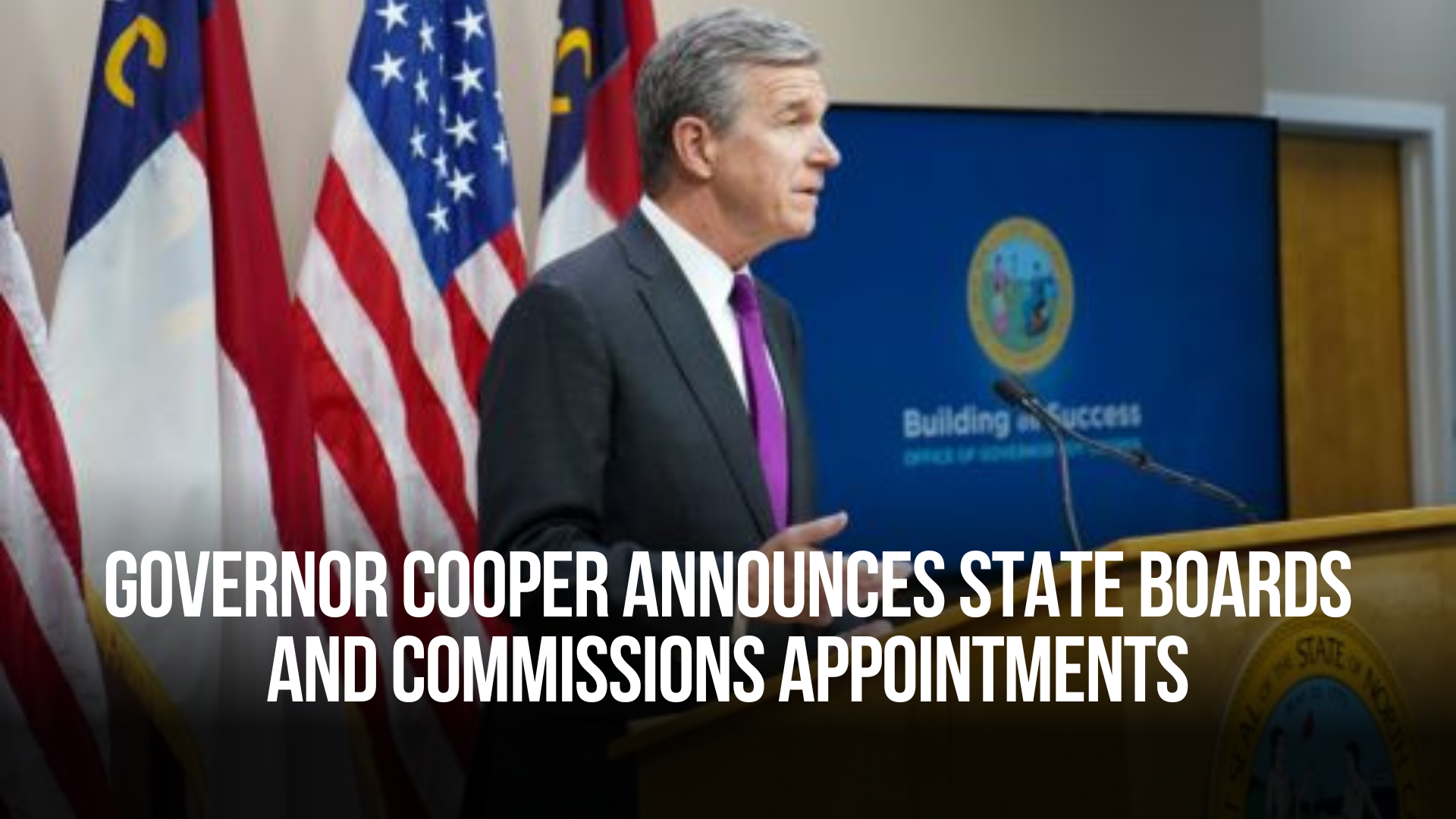
RALEIGH: Governor Roy Cooper announced appointments to boards and commissions.
Requiring able-bodied people to work in exchange for government benefits is a popular idea. It’s a proven way to reduce dependency and break the cycle of poverty. And in the case of the federally funded Supplemental Nutrition Assistance Program — what used to be called food stamps — it’s also the law.
I’m glad some members of Congress are finally looking into the harmful effects Pharmacy Benefit Managers (PBMs) have on patients, especially when it comes to the out-of-pocket costs that come along with many prescription drugs and treatments.
Governor Roy Cooper issued the following statement on the General Assembly's passage of Senate Bill 747 Elections Law Changes, which the General Assembly passed on Wednesday night, as well as other harmful bills also currently being pushed by extreme MAGA Republican legislators, Senate Bill 749 and House Bill 772:
RALEIGH — House Speaker Tim Moore told reporters last week that the North Carolina General Assembly is unlikely to craft and approve a state budget deal before Labor Day. That’s more than two months into the 2023-24 fiscal year that began July 1.