
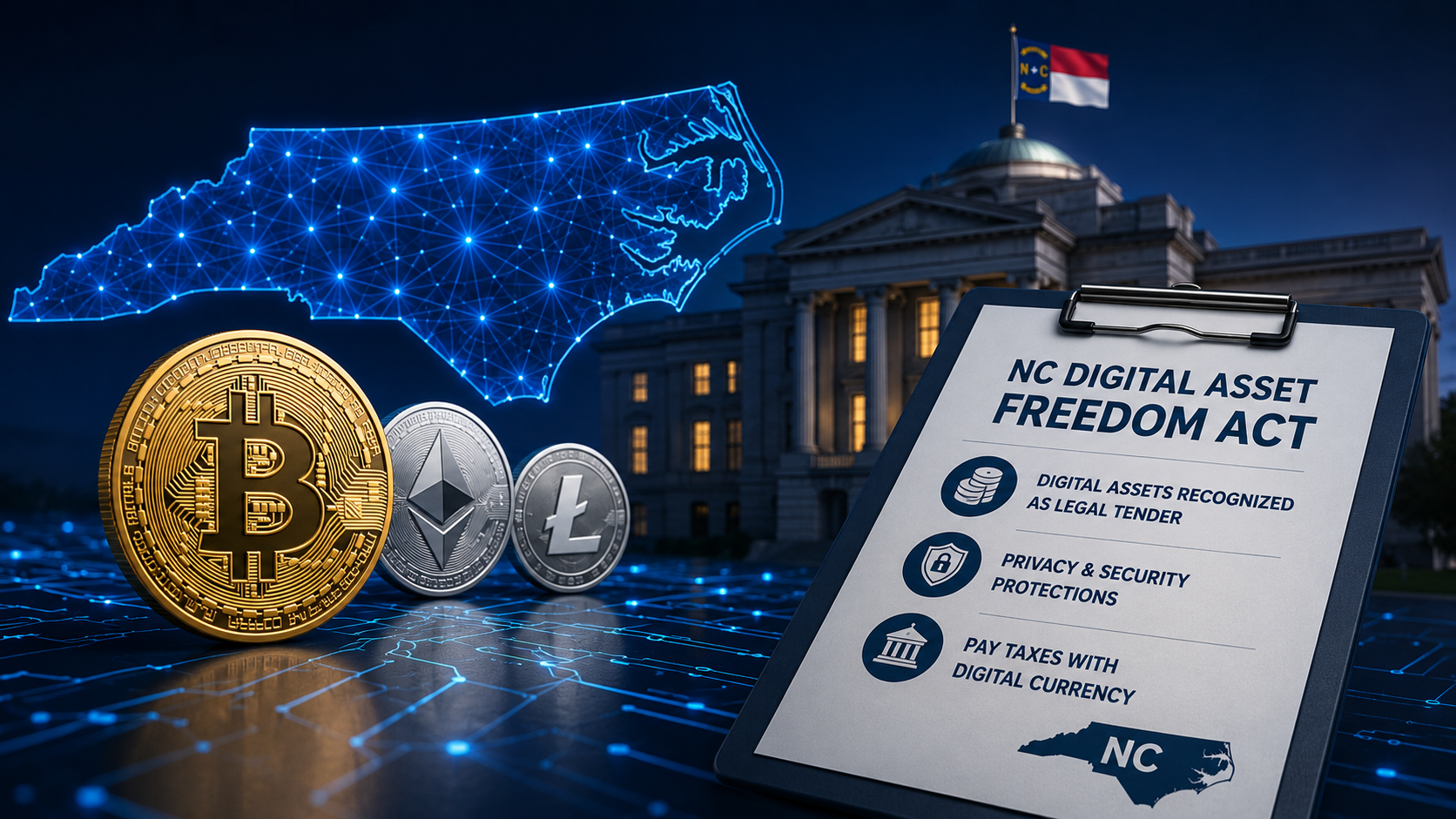
North Carolina lawmakers consider bill recognizing digital assets for tax payments, transactions
RALEIGH — North Carolina lawmakers are considering legislation that would recognize certain digital assets as a valid medium of exchange in the state and allow them to be used for tax payments under rules set by the Department of Revenue.
House Bill 920, titled the “NC Digital Asset Freedom Act,” was scheduled for consideration Tuesday in the House Commerce and Economic Development Committee, according to the North Carolina General Assembly calendar. The calendar listed a proposed committee substitute for the bill.
The bill was filed April 10, 2025, and sponsored by Republican Reps. Neal Jackson, Stephen Ross and Brian Biggs. It was referred April 14, 2025, to the House Commerce and Economic Development Committee, with additional referrals to Finance and Rules if approved.
According to the Legislative Reporting Service, the bill would create a new article in state law recognizing digital assets as useful for economic exchange and transactions. To qualify under the proposed law, a digital currency would have to meet several conditions, including at least 10 years of market longevity, a market capitalization of at least $750 billion, daily volume of at least $10 billion, commodity status from the federal Securities and Exchange Commission, a proof-of-work security mechanism and a predictable, non-inflationary supply.
The bill would recognize qualifying digital currency as a valid medium of exchange in North Carolina. It also would provide privacy and security protections for digital currency transactions and allow payment of taxes in digital currency as permitted under state tax law.
Under the proposal, the Department of Revenue would maintain digital currency exchange rates on its website and update them daily. The amount of a tax payment would be based on the digital-to-dollar exchange rate at the time of payment, while reported transactions would use the exchange rate at the time of the transaction.
The bill also includes consumer protection provisions for virtual currency kiosks. New customers would face a $2,000 daily transaction limit during the first 72 hours of use, and the bill would establish a refund process if a new customer was fraudulently induced to transmit currency through a kiosk.
The bill’s tax payment provisions were written to take effect Jan. 1, 2026, though the bill has not yet passed the General Assembly.
Editor’s note: This article was drafted with the assistance of artificial intelligence and was reviewed and fact-checked by a member of the NC Political News editorial team before publication.