Senate panel reviews bill on minors’ social media access, AI use in schools
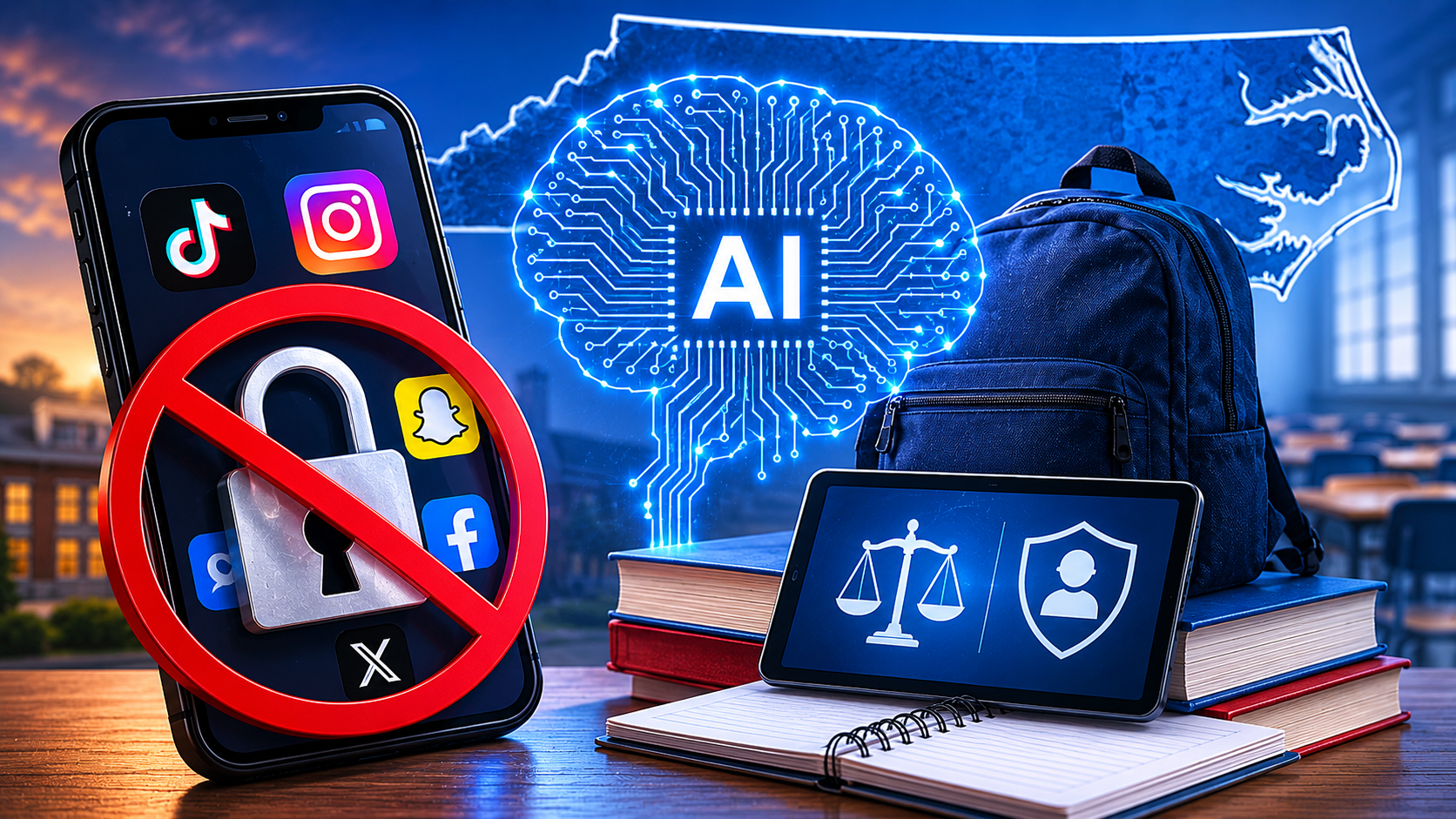
RALEIGH — A North Carolina Senate committee is reviewing legislation that would place new restrictions on social media accounts for minors younger than 16 and require public schools to adopt policies on artificial intelligence use.
House Bill 301, titled “Social Media & AI Safety,” was scheduled for discussion Tuesday in the Senate Judiciary Committee, according to the North Carolina General Assembly calendar. The calendar listed a proposed committee substitute for discussion only.
The bill passed the House in 2025 on a 106-6 second-reading vote before moving to the Senate. A Senate committee substitute was adopted April 29, and the bill was re-referred to Senate Judiciary.
The proposed Senate committee substitute would prohibit social media platforms from allowing minors younger than 14 to enter into contracts to become account holders. For minors who are 14 or 15, the bill would require parental or guardian consent before the minor could create or maintain an account.
The bill defines a covered social media platform as an online forum, website or application that allows users to upload or view content from other users, uses algorithms to select content, has certain addictive features and meets youth usage thresholds. The definition excludes services where the exclusive function is email or direct messaging, platforms primarily offering preselected news or entertainment content, customer support forums, interactive video game services with parental controls, online shopping and e-commerce.
Enforcement would be assigned to the North Carolina Department of Justice. The bill would allow the department to bring actions under the state’s unfair or deceptive trade practices law and seek civil penalties of up to $50,000 per violation. It also would allow minor account holders to bring claims for up to $10,000 in damages under certain circumstances.
The education portion of the bill would require the State Board of Education to adopt age-appropriate artificial intelligence literacy standards for kindergarten through 12th grade. Those standards would have to include responsible and ethical AI use, limitations of AI tools, verification of AI outputs, data and privacy concerns and safety when interacting with AI or chatbots.
The bill also would require the Department of Public Instruction to develop a model AI policy for public school units. Local boards of education, charter schools and other public school governing bodies would be required to adopt AI use policies after reviewing the model policy.
Editor’s note: This article was drafted with the assistance of artificial intelligence and was reviewed and fact-checked by a member of the NC Political News editorial team before publication.