
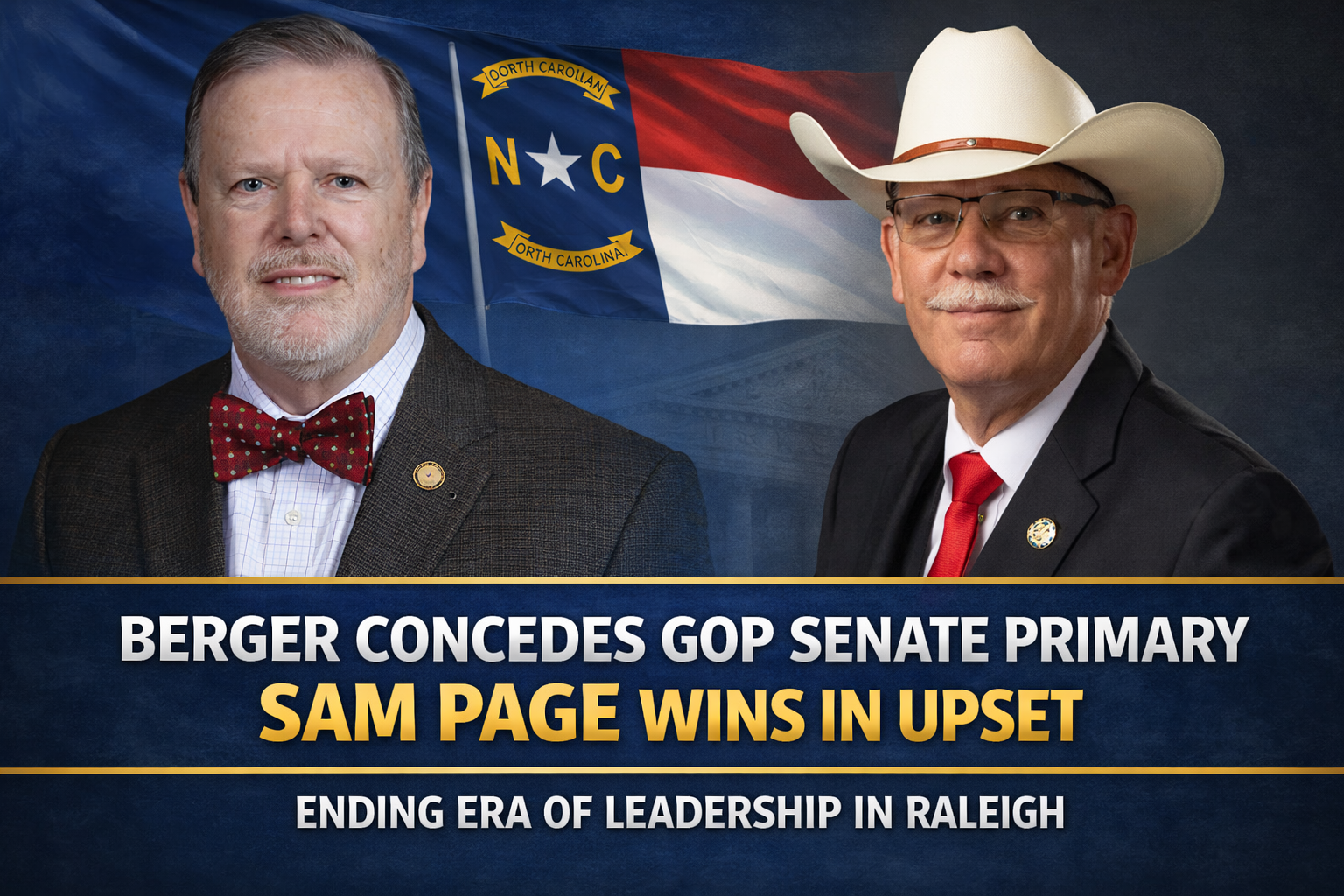
North Carolina Senate leader Phil Berger has conceded his Republican primary loss to Rockingham County Sheriff Sam Page, ending one of the most consequential election fights of the 2026 cycle and setting up a coming leadership shift in the General Assembly. Berger acknowledged the result Tuesday after a partial hand recount found no change in the vote totals and Page’s 23-vote lead held.
The race had become one of the state’s most closely watched post-primary contests because it involved the Senate’s top Republican and one of the most powerful figures in North Carolina politics. Berger has led the chamber since 2011 and has been a central architect of the legislature’s conservative agenda, including tax cuts, school-choice expansion, and efforts to shift power from Democratic governors to the Republican-led General Assembly.
With Berger stepping aside in the race, the story is no longer about recount mechanics. The better question now is what his defeat means for Senate leadership and for the direction of the Republican caucus heading into the next budget, tax, and policy fights. WRAL reported that Berger plans to serve out the remainder of his current term through the end of the year, after which Senate Republicans would choose a new leader if the party keeps control of the chamber.
Page’s win also carries a local political message. Multiple reports tied Berger’s vulnerability in the district to backlash over his support for a proposed casino in Rockingham County, an issue that drew unusually intense local resistance and gave Page a clear opening to argue Berger had lost touch with district concerns.
For North Carolina politics, the immediate effect is uncertainty at the top of the Senate. Berger’s influence extended well beyond his district, and his departure from the ballot reshapes the conversation around who will control the chamber’s agenda in 2027 and how stable the existing GOP power structure really is. In that sense, the concession is not just the end of a close primary. It is the beginning of a larger fight over succession, priorities, and power in Raleigh.
Editor’s note: This article was drafted with the assistance of artificial intelligence and was reviewed and fact-checked by a member of the NC Political News editorial team before publication.